Theme 1
The early electronic media led to the idea that the audience would be an undifferentiated mass. Trace thinking about audience from mass to "the long tail." Include discussion( And illustration) of how demographics and media genres created media audiences ,and the ways in which social media can create, in theory , an audience of 1 for many media experiences.
From the very beginning of electronic media, there was a huge fear that the once ever present and individual audience would soon be lumped together in this large undifferentiated mass. People thought that movies and radio programs and TV shows wouldn’t appeal to an individual person but instead would focus on a whole target audience allowing for only the most popular and money-making things to appear on air. While this idea seemed to be true when electronic media was emerging, I don’t believe it to be true now.
When radio first came out, it was immensely popular. People would sit in their living rooms around the radio and everyone seemed to have their favorite programs. This new fascination with the radio started to do what everyone feared though, create the image of the public as one mass audience. This would mean that the public would like the same things, be shocked and entertained by the same things, and would fear the same things. A classic example of the radio causing a mass frenzy would have to be an incident in the late 1930’s caused by Orson Wells and the radio broadcasting of his work, War of the Worlds. This broadcast included a scene in which aliens descended on Earth and as the scene was being read people were tuning in and because they had not heard the whole broadcast a widespread panic soon erupted. People all over the country started to get extremely upset and panic and this broadcast caused a mass frenzy throughout America. Though this is only one example of how early electronic media led to the idea of the mass audience, I do believe we have come a long way from that time. Now, due to things such as “the long tail” and even newer electronic media, the audience is becoming more and more differentiated and unique.
---Orson Welle’s War of the Worlds
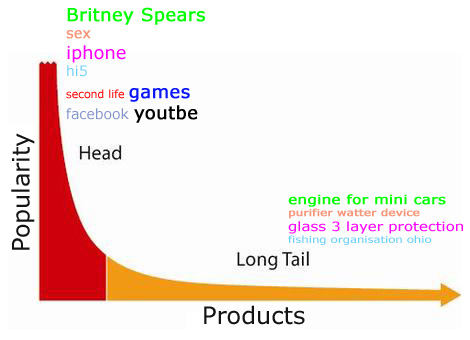
In Chris Anderson’s “The Long Tail,” he talks about all these new types of social media that don’t lump audiences together into one large mass, but instead separate the audience into different genres according to likes and dislikes. He mentions how even though record stores and movie theaters still do play to the popularity of a mass audience, which is not the social norm anymore. This long tail theory that is emerging is pretty simple once you actually take time to figure it out, and it is becoming increasingly popular. The long tail theory states that the distribution of selling small volumes of hard-to-find items to many customers instead of the distribution when only selling large volumes of popular items leads to a reduced number of the popular items. Furthermore, the total sales of this large number of “non-hit items” are called the Long Tail. While this whole drawn out definition seems confusing, it really just boils down to the fact that with these new mediums, such as Netflix and ITunes, there is just as much profit in carrying something that is not very popular as there is in carrying something that is popular. For these mostly online and electronic resources, there is just as much value in a popular movie or song as there is in an unpopular movie or song. A sale is a sale no matter what, and I believe this allows these new mediums to really focus on being able to provide anything that an audience member might need. This new way to stock and sell movies and music is completely different from the constant worry of shelf space in stores and ticket sales of the past. This new phase allows for individuality and audience distribution. It is in total opposition of the mass audience theories of the past.
The early electronic media led to the idea that the audience would be an undifferentiated mass. Trace thinking about audience from mass to "the long tail." Include discussion( And illustration) of how demographics and media genres created media audiences ,and the ways in which social media can create, in theory , an audience of 1 for many media experiences.
From the very beginning of electronic media, there was a huge fear that the once ever present and individual audience would soon be lumped together in this large undifferentiated mass. People thought that movies and radio programs and TV shows wouldn’t appeal to an individual person but instead would focus on a whole target audience allowing for only the most popular and money-making things to appear on air. While this idea seemed to be true when electronic media was emerging, I don’t believe it to be true now.
When radio first came out, it was immensely popular. People would sit in their living rooms around the radio and everyone seemed to have their favorite programs. This new fascination with the radio started to do what everyone feared though, create the image of the public as one mass audience. This would mean that the public would like the same things, be shocked and entertained by the same things, and would fear the same things. A classic example of the radio causing a mass frenzy would have to be an incident in the late 1930’s caused by Orson Wells and the radio broadcasting of his work, War of the Worlds. This broadcast included a scene in which aliens descended on Earth and as the scene was being read people were tuning in and because they had not heard the whole broadcast a widespread panic soon erupted. People all over the country started to get extremely upset and panic and this broadcast caused a mass frenzy throughout America. Though this is only one example of how early electronic media led to the idea of the mass audience, I do believe we have come a long way from that time. Now, due to things such as “the long tail” and even newer electronic media, the audience is becoming more and more differentiated and unique.
---Orson Welle’s War of the Worlds
In Chris Anderson’s “The Long Tail,” he talks about all these new types of social media that don’t lump audiences together into one large mass, but instead separate the audience into different genres according to likes and dislikes. He mentions how even though record stores and movie theaters still do play to the popularity of a mass audience, which is not the social norm anymore. This long tail theory that is emerging is pretty simple once you actually take time to figure it out, and it is becoming increasingly popular. The long tail theory states that the distribution of selling small volumes of hard-to-find items to many customers instead of the distribution when only selling large volumes of popular items leads to a reduced number of the popular items. Furthermore, the total sales of this large number of “non-hit items” are called the Long Tail. While this whole drawn out definition seems confusing, it really just boils down to the fact that with these new mediums, such as Netflix and ITunes, there is just as much profit in carrying something that is not very popular as there is in carrying something that is popular. For these mostly online and electronic resources, there is just as much value in a popular movie or song as there is in an unpopular movie or song. A sale is a sale no matter what, and I believe this allows these new mediums to really focus on being able to provide anything that an audience member might need. This new way to stock and sell movies and music is completely different from the constant worry of shelf space in stores and ticket sales of the past. This new phase allows for individuality and audience distribution. It is in total opposition of the mass audience theories of the past.
-
This illustration shows that even though there is a market for the popular products, the overall amount of sales really does equal the market for the unpopular products.
This illustration shows that even though there is a market for the popular products, the overall amount of sales really does equal the market for the unpopular products.
As a media-friendly culture, we have come an extremely long way. From the panic stricken mass audiences of the past to the very intuitive and individual new media audiences of the present and future, Americans and their relationship to media will never stop growing. As long as new technologies come out that make it easier and easier for developers and audiences to personalize and customize what they watch and listen too, media itself will become more and more personalized and less homogenous.

No comments:
Post a Comment