Theme 4
Starting with MacLuhan's ideas about how media create new environments and new ways of thinking,as a special case of technological determinism, explore the idea that we take on the qualities of the " intellectual technologies" we use,or, to put it another way, that media shape out thought processes. What are some concerns that have been expressed ( in articles such as " Is Google making us stupid?", "In Defense of to Distraction", and " Old fogies in their 20's") in relation to new media for our thinking attention and memory? In particular, discuss concerns about the decline in reading- especially the reading of books.
“The Medium is the Message,” this catch phrase that is most closely associated with Marshall MacLuhan has had generations pondering what exactly it means. Does the content of something matter as much as the medium through which the audience receives the content? Well, Marshal MacLuhan believes so. In the 1960’s he championed the idea that the media not only shapes how we learn things but also can cause psychological and social changes. Many people still believe this theory is true and work to provide evidence supporting the fact that the medium is the message.
-MacLuhan, “The Medium is the Message”
In the article, “Is Google making us stupid?” Nicholas Carr tells about how internet search engines are making it too easy too access not only any type of information but also to be tricked by the wrong information. He also believes that this total availability of information has made us lazy and not thorough when it comes to our work. While it is extremely simple to type in a key phrase or essay question into Google and have millions of answers right at your finger tips, there is no real learning value in that. There is no work put in, and this allows us to be extremely lazy. Despite the fact that half the information online is incorrect, it is irresponsible as a person to just do the bare minimum. This new ‘just scratching by’ attitude will get you nowhere in life. If we learn to expect everything to be handed to us, how we interact as human beings is going to change. This technology seems to be changing our whole thought processes from that of researchers and workers to that of “googlers”. In this case Carr proves that MacLuhan is right in the simple fact that this medium of internet search engines is changing how we think, act and approach any problem or question. We are becoming extremely lazy because it is extremely easy to access tons and tons of information on any topic.
Sam Anderson writes about another trait of humans that is being changed by new media, our ability to concentrate. With all these new gadgets and technologies it has become far too easy to be distracted from the task at hand. Cell phone text messages, Facebook notifications, TV, and IPods are all immense distractions when someone is attempting to do something. These technologies are so enticing that it is almost impossible for all your attention to be focused on one thing all at once. Anderson makes many comparisons as to how we are changing because of all this distraction but the main message is the same; if we cannot focus on one thing, nothing will get done. People will be too distracted to really do anything and then nothing at all will get done. This decline won’t be cause by people being last, instead people will be just too distracted by all the pretty new fun things for any work to get done. For example, when the IPhone first came out, according to the Weapon of Mass Destruction article, some of its main selling points were that it could multi-task, it was quick and easy, and people could do a wide variety of things on it. Humans, however, are not the IPhone and in order for something to be done right and well it must have all of our attention. This new obsession with being able to multi-task and allowing oneself to be distracted so easily is changing us as well. With so many different things going on at once, the ability to concentrate is being altered and new media is shaping us by impairing our ability to focus.
Generation gaps are predictable in any time periods. In recent decades, however, the gap seems to have grown larger and the gaps seem to come more frequently. This new quicker frequency of generation gaps is known as mini-generation gaps and is discussed in the article, “Children of Cyberspace: Old Fogies in their 20’s” by Brad Stone, along with many other generational aspects. According to Stone, children as young as ten have grown up dramatically different then children now. The emergence of all new technology so rapidly and how advanced it all is, is not only affecting adults but now also shaping how children grow up. Children now are extremely savvy when it comes to electronics and their mindset now tends to be centered more on instantaneous results and new electronic toys. Stone tells a story about his daughter believing the handheld electronic reading device Kindle is actually the only way to read. Stone’s daughter is not the only one who feels this way, in the podcast “For the Love of Reading” the book-like yet more personal aspect of Kindle is defended. It is stated that Kindle reads just how a normal text would, but whoever’s reading can zoom in or change the margins if necessary. Children reading books on Kindle will no longer need paperbacks or hard covered novels and will once again see how technology caters to them. This will shape how they see the world around them as they grow up and the harsher, less instantaneous realities of life set in. They will have to learn that not everything can be customized according to their standards and their relationships and way of thinking will suffer. Aside from how we think, Stone also makes a point of how technology shapes how we socially interact with others. Text messages and IM’s seem to be the only way anyone really communicates these days. Physically meeting someone and calling them on the phone is no longer necessary as social networking sites and texting become the new social norm. By affecting how children see the world as they grow up and form relationships, media is really changing yet another aspect of society.
-A very interesting review on Amazon’s Kindle
The media’s determinate role in society and in shaping our culture has become more prevalent over the years. People have allowed new media to shape how they think, solve problems, answer questions and form relationships with other people. While media has been doing this for decades, it seems to be happening more frequently in present years. So one question is left to be asked: how much will media shape us as humans in the future?
Wednesday, May 5, 2010

Final Blog
Theme3
Every form of technology that's become digital has also been transformed by its users/audience. Explain how at least three "old" media ( Books, tv, film, radio, newspapers) have adapted to new digital media forms, and how they have been changed by the process of becoming digital. Also describe the ways people use and change digitized media as consumers. Show some examples on your blog. Which "old" media do you think have promising futures in digital form, and which do you expect will die out soon? Support your answer with good arguments.
Every form of technology that's become digital has also been transformed by its users/audience. Explain how at least three "old" media ( Books, tv, film, radio, newspapers) have adapted to new digital media forms, and how they have been changed by the process of becoming digital. Also describe the ways people use and change digitized media as consumers. Show some examples on your blog. Which "old" media do you think have promising futures in digital form, and which do you expect will die out soon? Support your answer with good arguments.
As obvious as it is that media changes the way people think and interact, people have also changed media itself. Besides being physically responsible for technology itself, we as humans also determine what becomes popular and what gets expanded on and what falls by the wayside. We have a huge impact on media and examples such as books, radio, TV, and movies have all come as far as they have because of the human influence. We really determine just how advanced a certain media can and will become.
Books and literature have been around from the beginning of time. Everything from ancient history all the way up to the present has been recorded in books. In recent times there has been much less of an emphasis on books due to the decreasing popularity of stopping and reading a book. So, of course, books went digital. New technologies such as Kindle and the IPad and IPhone allow countless numbers of books to be stored and read on handheld electronic devices. While the text and content are the same, the experience is very different. People can personalize their reading experience by performing operations such as zooming in or highlighting the text and according to author Ann Kirschner these features are changing reading for the better. In her podcast “For the Love of Reading” Kirschner attempts to read a book using four different mediums. The simple fact that a Charles Dickens classic such as Little Dorritt can be read four different ways really does show how far media has come in relation to books. Consumers are definitely to blame for this shaping the advancement of literature into another electronic genre. Not many people have the patience or time to read as they used to and technological developers took advantage of this. Because no one wanted to read traditionally, a more digitized way of reading was created. We as humans have shaped reading into an easier more effortless form through technology and I believe this new form will continue to still grow.
 From books to E-books.
The radio is another classic form of media that has been around for ages. The radio was so evolutionary at its start that people had actually become almost like a huge conforming blob because of it. An example of this is found in the widespread panic that occurred due to a reading of Orson Well’s “War of the Worlds”. The next day there was an article in the New York Times, “Radio Listeners Panic, Taking War Drama as Fact,” that analyzed how the radio had really linked everyone together and caused this panic. The radio has also been manipulated by people from its very beginning. It has added and even changed forms and frequencies. Radio started as having just one frequency, AM, but soon people altered this by adding the FM frequency and eventually culminating in a totally new form, satellite radio. Besides the technological advances the radio has experience, there was an even bigger advancement that somewhat strayed from the actual radio.

This advancement was much more visual and is now known as the television, and though the radio was immensely popular in its day, there still is no comparison to America’s most persistent and influential medium. TV is present everywhere, there are a very miniscule amount of homes that do not own at least one TV and in most of the homes the TV is on 24/7. In class we learned how TV programs are shaped by popularity and how advertisers try to manipulate TV for their own uses. As in the other mediums, TV has also been shaped by the public. We create the shows, and each shows success depends on how we perceive it. If a show is not popular advertisers will not want to buy up commercial space, therefore the show will not make money. Besides this direct effect people have on TV, the advancements in TV also shape this popular technology. The invention of High Definition has made watching TV so much more enjoyable and exciting because of the crystal clear picture. Websites such as Hulu and the option of DVR have even eliminated the need for commercials and have also transformed how people watch TV. The TV experience is now much more customized and allows each individual to watch only what they want. In the future it is believed that there will not really be a need for commercials and to combat this Mittell mentions in The Velvet Trap that advertisers will now try to place their products in the actual shows themselves, because the viewing of commercials has dramatically reduced. People have once again influenced this medium and it was forced to adapt. The TV is a staple however and I don’t see TV distorting in the years to come as some other mediums have, I think it will only advance.

We are now in a shift, “from book fluency to screen fluency,” as Kevin Kelly states in his article, Becoming Screen Literate and movies are a huge part of this shift. Kelly notes that it seems that everywhere we turn movies and advertisements for movies are there. Once going to the movies was a novelty, something that was an adventure and experience and now it has become commonplace and almost boring. Movies seem to have lost most of their charm and popularity and because of this decrease in attention, the movie industry has had to adapt. Movies have become much more technologically advanced, with aspects like amazing special effects, 3-D elements, and famous actors and actresses starring in every role. People have had a major effect on the movie industry because many people simply just do not go anymore. With new developments like Netflix and Movies on Demand, the movie theater is in even more trouble. Netflix and On Demand allow people to order up a movie and have it either mailed to them or sent directly to their TV. If watching a movie is this easy, there doesn’t seem to be a need to actually go out to the movies at all. This new digitized form of this older medium has become extremely popular and very successful as far as technological advancements go. It will be interesting to see how far this new ‘screen fluent’ generation takes movies in the future.

Though many “old” media forms have become digital and transformed into new media forms, the older media has attempted to keep its integrity as best it can. People are determined to allow these old media to advance but not to the point where it is unrecognizable. As people shape the development of new media more and more, we can only hope the old media still retains some of what made it that omnipresent force it started out as.
Final Blog
Theme 2
Explain Meyrowitz's theory as it applies to relationships enabled by electronic media, and trace the evolution of such mediated relationships from Mary Dyck to twitter, including discussion of parasocial interaction, ambient awareness, 'hook-ups" through IM-ing, and other examples you see as relevant
The Medium Theory, which states that the emphasis of communication is being places not so much on the content but on the medium through which the communication is made, is a theory that has been explored for decades. At the forefront of this discussion are two very intelligent writers, Joshua Meyrowitz and Marshall MacLuhan. While MacLuhan’s theory focuses more on the medium through which the communication is made, Meyrowitz’s theory focuses more on the technological contents of media beyond its apparent content. Meyrowitz’s looks beyond the media itself and attempts to explore such ideas that we now know as parasocial interaction and ambient awareness. In 1986 Meyrowitz published his book No Sense of Place and through this book really showed how technologies have worked to influence and to shape the social interactions that now take place today. From the very early stages of the radio all the way to television and the new online networking sites (Twitter and Facebook), technology has worked to shape the way we as humans interact with each other.
As radio began to emerge as the new inventive technology people started to become amazed at how popular it became so quickly. The radio was an entertainment medium that connected people all over the country. Even though this social networking was primitive, it still worked to help people interact. The Radio Diaries of Mary Dyck are a perfect example in that they showed how important radio was to farm women who had no other link to the world. Radio provided a way for people living in the margins of society to be able to connect to any and everyone they wanted. As radio progressed, new stations and frequencies such as AM FM, and now satellite radio XM, worked to shape peoples relationships even more. As was stated in the film “Rock Jocks” where would Woodstock, or even the Vietnam War, have been without the help of all those pioneer FM dj’s. Radio showed people how to stand up and gave them a voice, helped connect them others all over the world and led the way for new social interaction mediums to emerge.
As technology improved, the way people interacted with each other changed as well. The next major shift in social interaction came about due to the increase in popularity and development of internet social networking sites. Twitter, Facebook, personal ads, blogs, gossip and newspaper websites are all newer and much more personal versions of the connectivity that the radio gave way to. Accessing someone’s personal information, seeing pictures and knowing their daily activists are all available on these mediums and people take full advantage. There has even been a new theory, known as parasocial interaction, which is becoming extremely popular. A parasocial relationship is one in which one party knows a second party but the second party knows nothing about the first. It is a very one-sided relationship that is made extremely easy by Facebook and Twitter where everything is out in the open. This definitely shapes how people interact with each other. Without ever meeting someone Facebook can tell you everything you need to know about that person. People who would have never met in person can now meet, talk and form a relationship. In Walter Kern’s article, A Christmas Love Story, Kern talks about how he met his wife on Facebook over Christmas one year. Something like this could never have happened without these new social mediums.
The link to Kern’s Times article:
http://www.nytimes.com/2009/12/20/magazine/20FOB-WWLN-t.html?_r=1&scp=1&sq=Digital+Mistletoe&st=nyt
Another factor that contributes to social relationships becoming more and more internet centered is the new technologies that make it faster and easier to access the internet. Gadgets like the IPhone and Blackberry and laptop computers all make accessing information and interacting with other people extremely fast and easy. These technologies can all access the internet and are handheld which means they can be taken anywhere. People can receive emails, ‘tweets’, and Facebook notifications all on their cell phones. This makes talking to others and forming relationships a near constant thing. Due to this idea of ‘ambient awareness’ it is now being stated that people can pick up emotions through texts or I.M’s, just as people have been picking up emotions through body language and tones. If this theory proves true, then it seems that there will soon be no need to even really see people at all when talking to them.

While this non-verbal communication probably will not end up being the only form of communication it is becoming extremely popular. This incessant online contact, as is stated in the article “I’m so Digitally Close to You”, is becoming a phenomenon. Micro-blogging, seen mostly in Twitter and Facebook statuses, is now starting to be the chief way we find out what is going on in others lives. Meeting and ‘hooking up’ with others online seems to be the main way anyone develops a relationship. The emphasis of face-to-face contact in modern culture is very minimal and with the development of even more new social mediums one is left to wonder, will seeing someone in person even be necessary to form a relationship in the future?


Final Blog
Theme 1
The early electronic media led to the idea that the audience would be an undifferentiated mass. Trace thinking about audience from mass to "the long tail." Include discussion( And illustration) of how demographics and media genres created media audiences ,and the ways in which social media can create, in theory , an audience of 1 for many media experiences.
From the very beginning of electronic media, there was a huge fear that the once ever present and individual audience would soon be lumped together in this large undifferentiated mass. People thought that movies and radio programs and TV shows wouldn’t appeal to an individual person but instead would focus on a whole target audience allowing for only the most popular and money-making things to appear on air. While this idea seemed to be true when electronic media was emerging, I don’t believe it to be true now.
When radio first came out, it was immensely popular. People would sit in their living rooms around the radio and everyone seemed to have their favorite programs. This new fascination with the radio started to do what everyone feared though, create the image of the public as one mass audience. This would mean that the public would like the same things, be shocked and entertained by the same things, and would fear the same things. A classic example of the radio causing a mass frenzy would have to be an incident in the late 1930’s caused by Orson Wells and the radio broadcasting of his work, War of the Worlds. This broadcast included a scene in which aliens descended on Earth and as the scene was being read people were tuning in and because they had not heard the whole broadcast a widespread panic soon erupted. People all over the country started to get extremely upset and panic and this broadcast caused a mass frenzy throughout America. Though this is only one example of how early electronic media led to the idea of the mass audience, I do believe we have come a long way from that time. Now, due to things such as “the long tail” and even newer electronic media, the audience is becoming more and more differentiated and unique.
---Orson Welle’s War of the Worlds
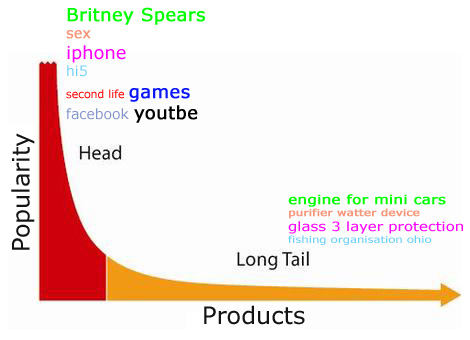
In Chris Anderson’s “The Long Tail,” he talks about all these new types of social media that don’t lump audiences together into one large mass, but instead separate the audience into different genres according to likes and dislikes. He mentions how even though record stores and movie theaters still do play to the popularity of a mass audience, which is not the social norm anymore. This long tail theory that is emerging is pretty simple once you actually take time to figure it out, and it is becoming increasingly popular. The long tail theory states that the distribution of selling small volumes of hard-to-find items to many customers instead of the distribution when only selling large volumes of popular items leads to a reduced number of the popular items. Furthermore, the total sales of this large number of “non-hit items” are called the Long Tail. While this whole drawn out definition seems confusing, it really just boils down to the fact that with these new mediums, such as Netflix and ITunes, there is just as much profit in carrying something that is not very popular as there is in carrying something that is popular. For these mostly online and electronic resources, there is just as much value in a popular movie or song as there is in an unpopular movie or song. A sale is a sale no matter what, and I believe this allows these new mediums to really focus on being able to provide anything that an audience member might need. This new way to stock and sell movies and music is completely different from the constant worry of shelf space in stores and ticket sales of the past. This new phase allows for individuality and audience distribution. It is in total opposition of the mass audience theories of the past.
The early electronic media led to the idea that the audience would be an undifferentiated mass. Trace thinking about audience from mass to "the long tail." Include discussion( And illustration) of how demographics and media genres created media audiences ,and the ways in which social media can create, in theory , an audience of 1 for many media experiences.
From the very beginning of electronic media, there was a huge fear that the once ever present and individual audience would soon be lumped together in this large undifferentiated mass. People thought that movies and radio programs and TV shows wouldn’t appeal to an individual person but instead would focus on a whole target audience allowing for only the most popular and money-making things to appear on air. While this idea seemed to be true when electronic media was emerging, I don’t believe it to be true now.
When radio first came out, it was immensely popular. People would sit in their living rooms around the radio and everyone seemed to have their favorite programs. This new fascination with the radio started to do what everyone feared though, create the image of the public as one mass audience. This would mean that the public would like the same things, be shocked and entertained by the same things, and would fear the same things. A classic example of the radio causing a mass frenzy would have to be an incident in the late 1930’s caused by Orson Wells and the radio broadcasting of his work, War of the Worlds. This broadcast included a scene in which aliens descended on Earth and as the scene was being read people were tuning in and because they had not heard the whole broadcast a widespread panic soon erupted. People all over the country started to get extremely upset and panic and this broadcast caused a mass frenzy throughout America. Though this is only one example of how early electronic media led to the idea of the mass audience, I do believe we have come a long way from that time. Now, due to things such as “the long tail” and even newer electronic media, the audience is becoming more and more differentiated and unique.
---Orson Welle’s War of the Worlds
In Chris Anderson’s “The Long Tail,” he talks about all these new types of social media that don’t lump audiences together into one large mass, but instead separate the audience into different genres according to likes and dislikes. He mentions how even though record stores and movie theaters still do play to the popularity of a mass audience, which is not the social norm anymore. This long tail theory that is emerging is pretty simple once you actually take time to figure it out, and it is becoming increasingly popular. The long tail theory states that the distribution of selling small volumes of hard-to-find items to many customers instead of the distribution when only selling large volumes of popular items leads to a reduced number of the popular items. Furthermore, the total sales of this large number of “non-hit items” are called the Long Tail. While this whole drawn out definition seems confusing, it really just boils down to the fact that with these new mediums, such as Netflix and ITunes, there is just as much profit in carrying something that is not very popular as there is in carrying something that is popular. For these mostly online and electronic resources, there is just as much value in a popular movie or song as there is in an unpopular movie or song. A sale is a sale no matter what, and I believe this allows these new mediums to really focus on being able to provide anything that an audience member might need. This new way to stock and sell movies and music is completely different from the constant worry of shelf space in stores and ticket sales of the past. This new phase allows for individuality and audience distribution. It is in total opposition of the mass audience theories of the past.
-
This illustration shows that even though there is a market for the popular products, the overall amount of sales really does equal the market for the unpopular products.
This illustration shows that even though there is a market for the popular products, the overall amount of sales really does equal the market for the unpopular products.
As a media-friendly culture, we have come an extremely long way. From the panic stricken mass audiences of the past to the very intuitive and individual new media audiences of the present and future, Americans and their relationship to media will never stop growing. As long as new technologies come out that make it easier and easier for developers and audiences to personalize and customize what they watch and listen too, media itself will become more and more personalized and less homogenous.
Subscribe to:
Posts (Atom)